

...about the people...

Why?
Agile Testing and Holistic Testing book author Lisa Crispin had published a short, poignant post on Agile Testing with Lisa Crispin, titled “Is it still all about the people?”.
In it, the author recalls how Kent Beck’s book Extreme Programming Explained had emphasized that successful software development depends on putting people first: Creating psychological safety, enabling learning, sharing responsibility, and collaborating closely with customers may enable high‑performing, happy teams.
However, the current AI-assisted development wave seems much more obsessed with tools than people: Organizations with existing “people problems” find themselves struggling [more], mainly as leadership considers AI as a way to replace employees instead of fixing any [underlying] human and organizational issues.
The author concludes this article with a hanging question:
…am I just not looking in the right places?
Have we come to that day when the robots replace us?
If so, where the heck are our flying cars?
I was moved by this article mainly as I had similar questions for many years1.
And I was looking for answers.
And I wanted to answer the author, but the answer got long…
So here it is, in a concise form.

Extreme Programming Explained
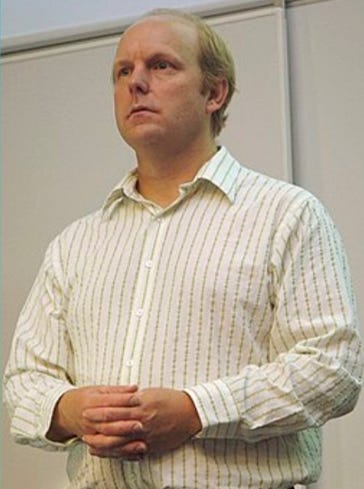
The first edition of Kent Beck’s Extreme Programming Explained was published in October 19992; in it, Kent Beck had explicitly stated that Extreme Programming (XP) is fundamentally about people and social change, not just coding techniques or process mechanics. The second edition’s first chapter is summarized with—
XP is about social change…
Beck’s point was that XP is about changing habits, patterns, and relationships so people can do better work together: As productivity and confidence depend as much on human factors as on technical skills, a key to better performance lies with focusing on human relationships, communication, and trust.
Beck’s practices, framed as ways to improve human interaction, became quite common: Sitting together, pair programming, sharing code ownership, and real customers’ involvement kept effective teams together.
The book covered technical practices, of course, but the core message and organizing principles were centered on people, teams, and social dynamics in software development.
The Mythical Man-Month
Beck’s book was [first] published quadranscentennially after The Mythical Man-Month: Essays on Software Engineering by Frederick P. Brooks Jr. 3
Brooks explained that the whole book grew out of Tom Watson Jr.’s question to him at IBM: essentially—
You’ve managed hardware and you’ve managed software;
what’s the difference,
and why is programming so hard to manage?
Brooks spans in his book various ideas, including—
Brooks’s Law: “Adding manpower to a late software project makes it later.”4
The “man‑month” myth: “One person for 12 months” is not interchangeable with “12 people for 1 month.”5
Project management and estimation: Why software schedules are so often wrong6.
Conceptual integrity and small, strong design leadership: Big systems need a coherent design “vision.”7
And—tada!—People and teams over tools: The main problems in software projects are sociological (how people work together), not purely technological.

The Agile Manifesto
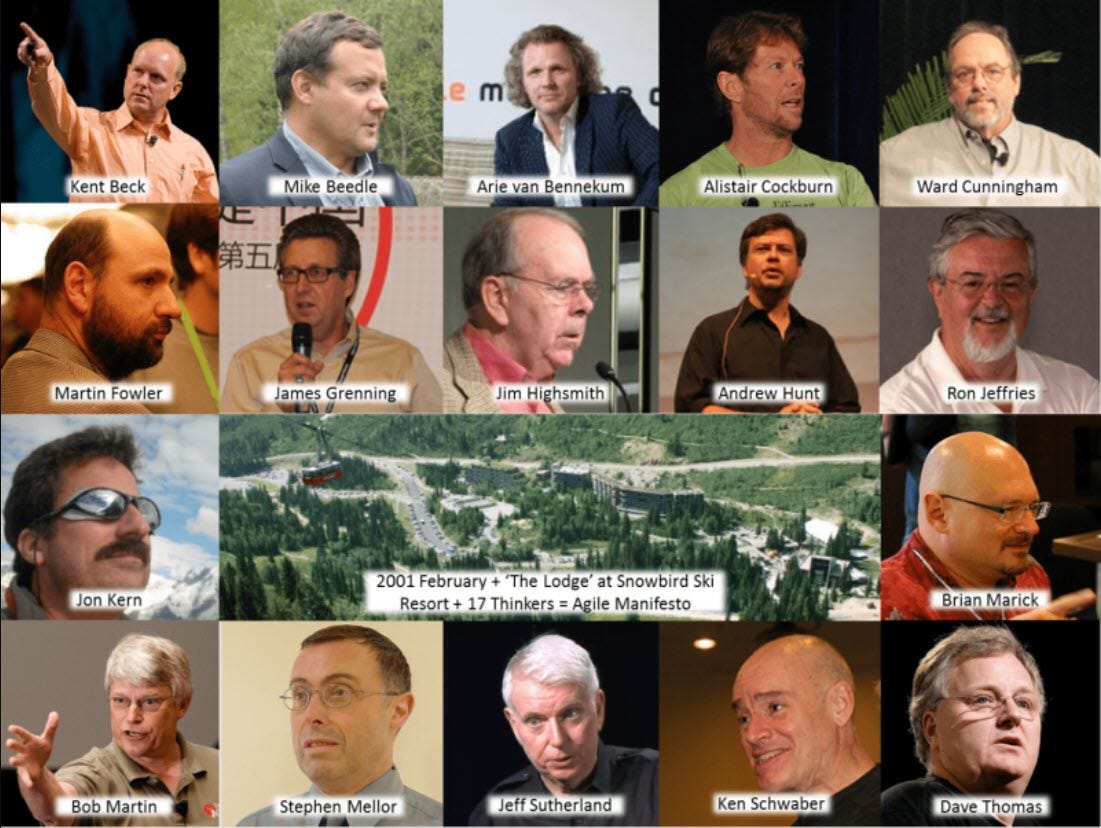
Kent Beck was one of the 17 original authors/signers of the Agile Manifesto in February 2001. As the creator of Extreme Programming (XP), his XP ideas, values (communication, feedback, simplicity, and courage), and practices (small increments and close customer collaboration) strongly shaped the Agile Manifesto’s four core values:
Individuals and interactions over processes and tools
Working software over comprehensive documentation
Customer collaboration over contract negotiation
Responding to change over following a plan
People usually refer to8 §1, “forgetting” the goal (§2), the road (§4), and the purpose (§3).
Out of the Crisis
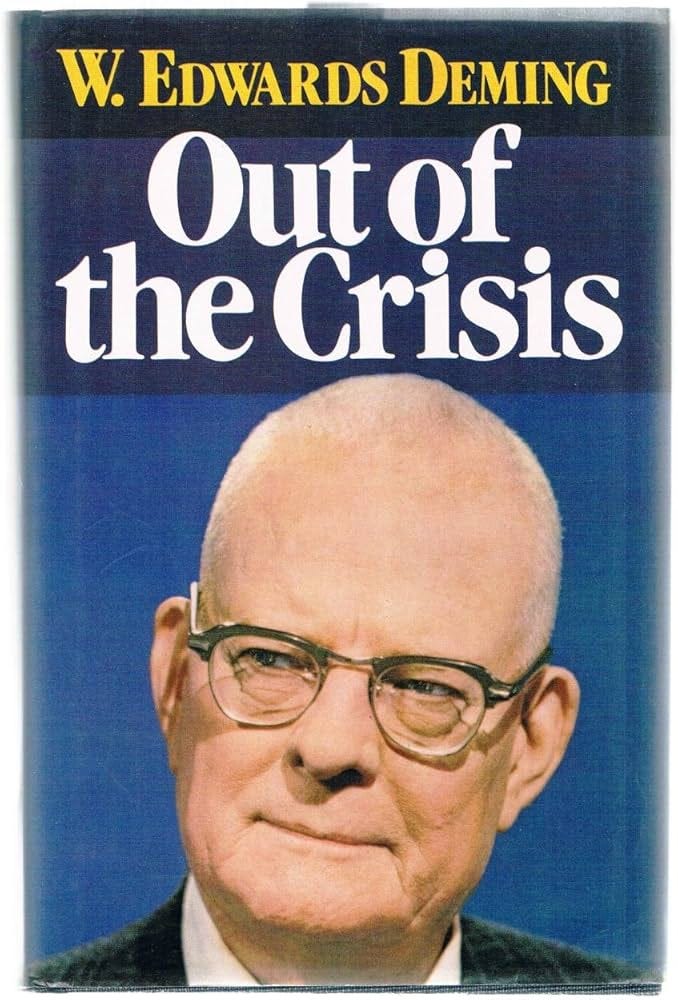
W. Edwards Deming’s work in manufacturing quality, mainly—Out of the Crisis [1982], included the famous 14 Points for Management9.
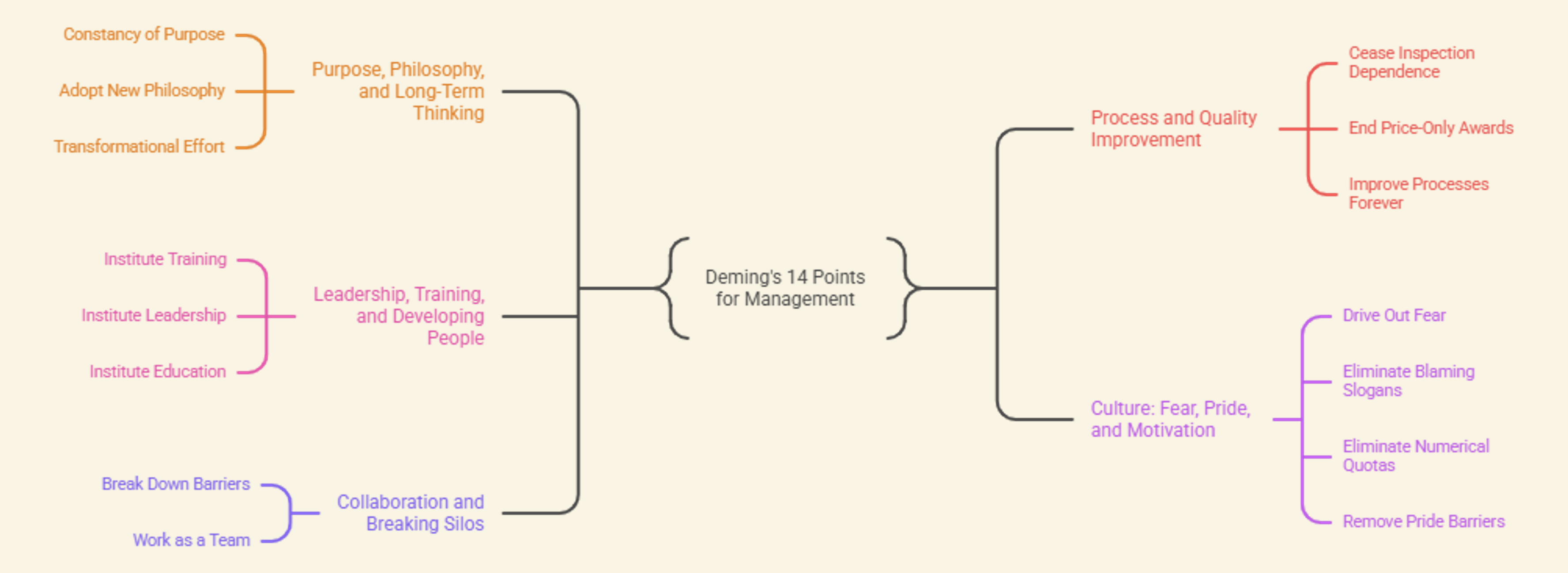
These principles may be categorized thus:
Deming had explained his approach, referring to concerns mentioned above:
Shift of focus to people and systems:
Deming’s argument was, that most quality problems come from the system and management, not from “bad workers”.
Beck emphasized that productivity and quality come from team habits, safety, and collaboration rather than heroic individual programmers.From local optimization to holistic thinking:
Deming pushed manufacturers to see the whole production system (variation, feedback loops, suppliers, and learning).
Beck’s XP treats the entire socio-technical system (team, customer, feedback, tests) rather than isolated coding practices.Practical principles plus philosophy: Both combine concrete practices10 with an underlying philosophy about respect for people and continuous improvement.
The “people” thing was a key component, but certainly—not the main dish…11
Is this a new thing?
Let’s go back in time.
About 260 years.
During the first industrial revolution, people who moved into the new industrial workplaces faced many “about the people” problems, and those were quite severe:
Loss of traditional, face‑to‑face community12, harsh working conditions and lack of voice13, communication between workers and owners was mostly one‑way14, coordination and control in large, new organizations formation15, new mass‑communication patterns with uneven access emerged16, emergence of collective communication (unions, movements)17.

We could go even further: The Bible shares affairs of—
“Micromanagement” perils18
Conflict and authority management19
Strategic Planning and Resource Management20
Leadership under pressure21
Coordination and communication22

For 50 years, 260 years, and [roughly] 3000 years, it is all about the people!
BUT, since the first humans started collaborating, the purpose was to gain some value, achieve a certain goal, acquire a specific improvement.
It was never “just” all about the people.
But the software industry is superior:
Developers [turned to be] / [are] / [perceive themselves as] “artists”, “complex”, “hi-tech”, their “personality” more important than most [all?] other professionals…
For the last 50, 25, 2.5 years we see them23 talking, discussing, thinking, planning, exercising, forming new “ceremonies”, pumping “people” notions that serve very little value to their firms, if at all…
And now they are surprised to find, that their managements find it better, more beneficial, to replace them with machines.
Surprise! (?)
This surprise was common to all workers when progress came in and machines (or other devices) had offered better, faster, safer alternatives to human labor.
Industries grew stronger, humanity stepped forward, and employees progressed.
I attended a convention in the late 1980s, where lecturer talked about robotics;
he pointed out the unemployment perils as of robots replacing workers.
A person in the back of the auditorium raised his hand to comment.
He said, that the lecturer’s claim is inaccurate, at best.
Take for example Japan, he said.
The ratio of robots per capita in Japan is much larger than in the UK,
whereas unemployment ratios in the UK are higher than in Japan.
Why was that so?
Because the Japanese pulled their “replaced” personnel, trained and taught them, and moved them higher in design, planning, production, and manufacturing chains.
Such changes were applied in most industries for as long as humans were looking for new, improved ways to do…everything…24
It is all about the people
It is the arrogance of software development people that makes them flabbergasted.
And it’s because it is not an actual, physical “robot”…is it…?
It’s like their own golem25 rose upon them…26
Might it be, that this industry should, at long last, start behaving like most other human endeavors…?
Yes.
It is all about the people.
Let that sink.

Related Posts:


…also—more on Agile, disruption, management, product management, software…
Since the last millennium.
A long time.
Really.
The same year, he published his Refactoring: Improving the Design of Existing Code.
A second edition, Extreme Programming Explained: Embrace Change, was published in November 2004 [Kent Beck and Cynthia Andres].
This is not going to be a full literture review, of course; just mentioning main milestones…
As team size grows—communication and coordination overhead explode;
progress does not scale linearly with the number of people.
Not all tasks may be parallelized;
ramp‑up and communication costs mean—more people can slow things down.
This is often best achieved by a small group or “surgical team,” rather than by a committee.
Read: “Emphasize, adorn, preach, put forth…” (add your favorites…)
Briefly—
Create constancy of purpose for improving products and services.
Adopt the new philosophy
(recognize we are in a new economic age; management must lead change).Cease dependence on inspection to achieve quality;
build quality into the process instead.End awarding business on price tag alone;
minimize total cost via long-term relationships with suppliers.Improve constantly and forever every process of production and service.
Institute training on the job.
Adopt and institute leadership that helps people do a better job,
rather than just supervising.Drive out fear so everyone can work effectively for the organization.
Break down barriers between departments;
make different functions work as a team.Eliminate slogans, exhortations, and targets for the workforce
that demand better performance without fixing the system.Eliminate numerical quotas and numerical goals that push people
to meet numbers instead of improving quality.Remove barriers that rob people of pride in workmanship
(including annual ratings and merit systems).Institute a vigorous program of education and self‑improvement for everyone.
Put everybody in the company to work to accomplish the transformation;
the change is everyone’s job.
Deming promoted statistical quality control, Beck—TDD, pairing, refactoring…
In 2004, Prof. Jeffrey K. Liker had published The Toyota Way: 14 Management Principles from the World’s Greatest Manufacturer, which may be categorized thus:
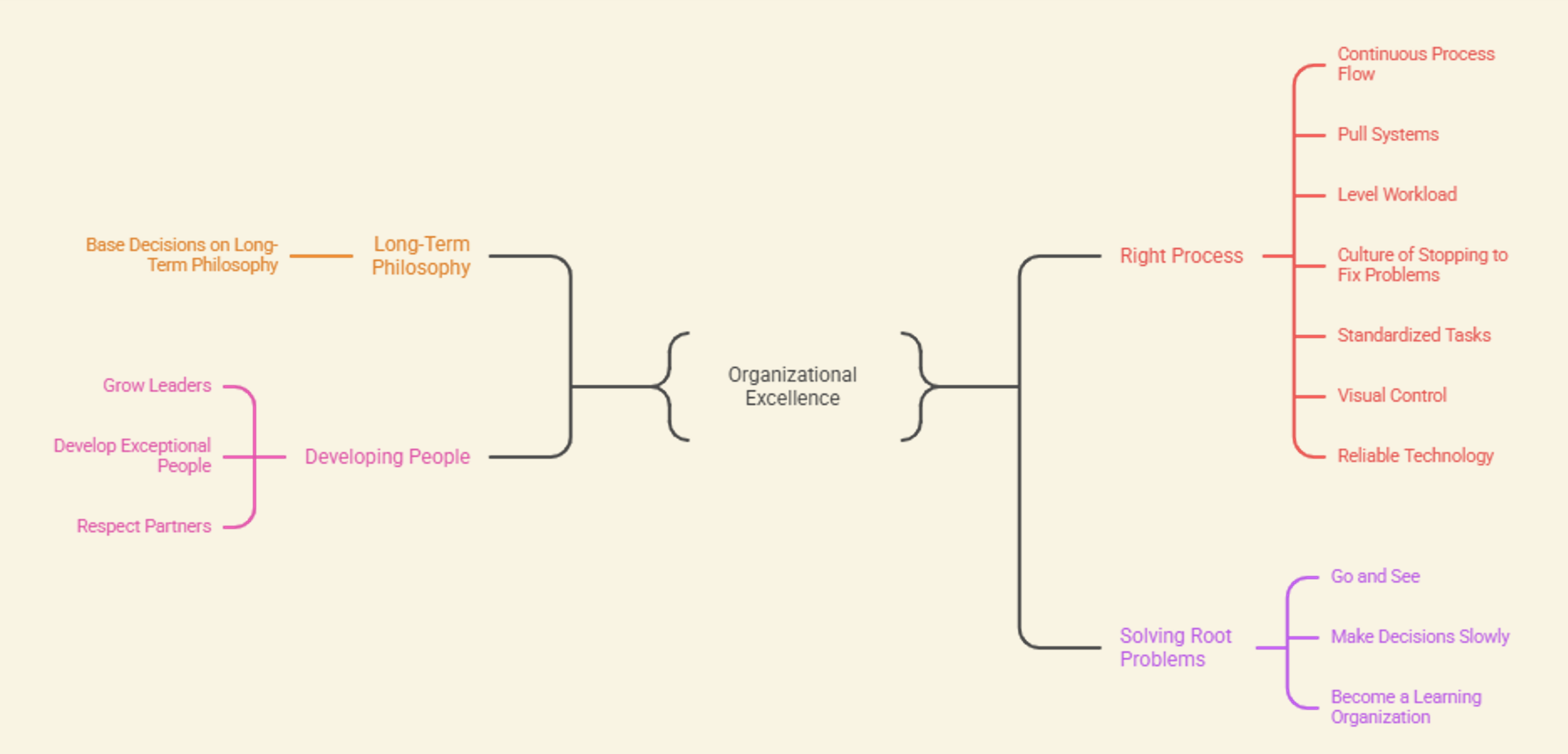
[Deming influenced Toyota; Liker studied Toyota and wrote about how Deming’s ideas show up there.]
As many workers moved from small rural communities and home-based craft work into crowded industrial cities and large factories, traditional family and village networks weakened, hence—people had less informal, trust‑based channels for sharing information, grievances, and support.
Factory work often meant 12–16 hour days, low wages, dangerous machinery, and child labor, with almost no legal protections.
Orders went down, very little real feedback going up.
Problems and frustrations were not heard or addressed until they exploded into unrest or organizing.
Owners and managers suddenly had to coordinate hundreds of workers instead of a few apprentices, so they relied on rigid rules, supervision, and hierarchies rather than dialogue.
This created distance and mistrust: workers saw management as remote and uncaring, while managers saw workers as interchangeable “hands,” not people to communicate with or involve in decisions.
Printed materials, newspapers, and later—telegraph and rail systems—greatly accelerated the spread of information, including about working conditions and politics.
However, literacy and access were uneven, so many workers depended on others to interpret news, which could distort or polarize communication between classes and groups.
As individuals had little voice, workers increasingly turned to collective forms of communication: trade unions, mutual aid societies, and political movements.
These groups became channels for articulating grievances, negotiating with employers, and coordinating strikes and reforms, filling the gap left by the lack of direct, respectful worker–management communication.
Exodus XVIII, 13-26: Moses judged all the people by himself, which created a heavy burden and inefficiency. Jethro suggests that he appoint chiefs of thousands, hundreds, fifties, and tens to resolve the bottleneck effect, exercise empowerment and scalability, and achieve control span by leadership recruitment.
Numbers XVI: Korah and his assembly challenge the authority of Moses and Aaron, creating a leadership crisis of confidence, requiring handling internal opposition while maintaining authority without escalating the conflict, and—of course—managing organizational politics.
Genesis XLI: Joseph advises Pharaoh to store food during the years of abundance in preparation for the years of famine, requiring long-term strategic thinking, crisis management, resource planning, and leading change on a national scale (including many “about the people” aspects…)
Book of Nehemiah details the effort to organize the people to rebuild Jerusalem’s wall despite both external and internal opposition. This called for team management during crisis, maintaining motivation, dealing with resistance and efficient division of labor.
Genesis XI tells about The Tower of Babel, presenting a devastating failure in coordination and communication: When language was confused—cooperation collapsed, demonstrating the importance of clear communication, interdependence between teams, and the shared language as a foundation for management.
…and hear them, for the blabber never stops…
To answer the question “…where the heck are our flying cars?”—
let’s think about coach riders and horsemen over the ages,
who lost their jobs to trains, cars, and trucks.
Post image is an adaptation of an illustration of the Golem by Mikoláš Aleš from Ancient Bohemian Legends.
I do not, in any way, dismiss the grave issues with current AI hype.
Most are derivatives of same arrogant, immoral, and greedy traits of this industry.